Bratislava in a Day
Two capitals an hour apart — the closest pair in Europe. One ticket covers the train there, the trams, and the ride home.
The short version
- Trains leave Wien Hauptbahnhof hourly for Bratislava hlavná stanica, about an hour flat; fares and the day-return deal at oebb.at.
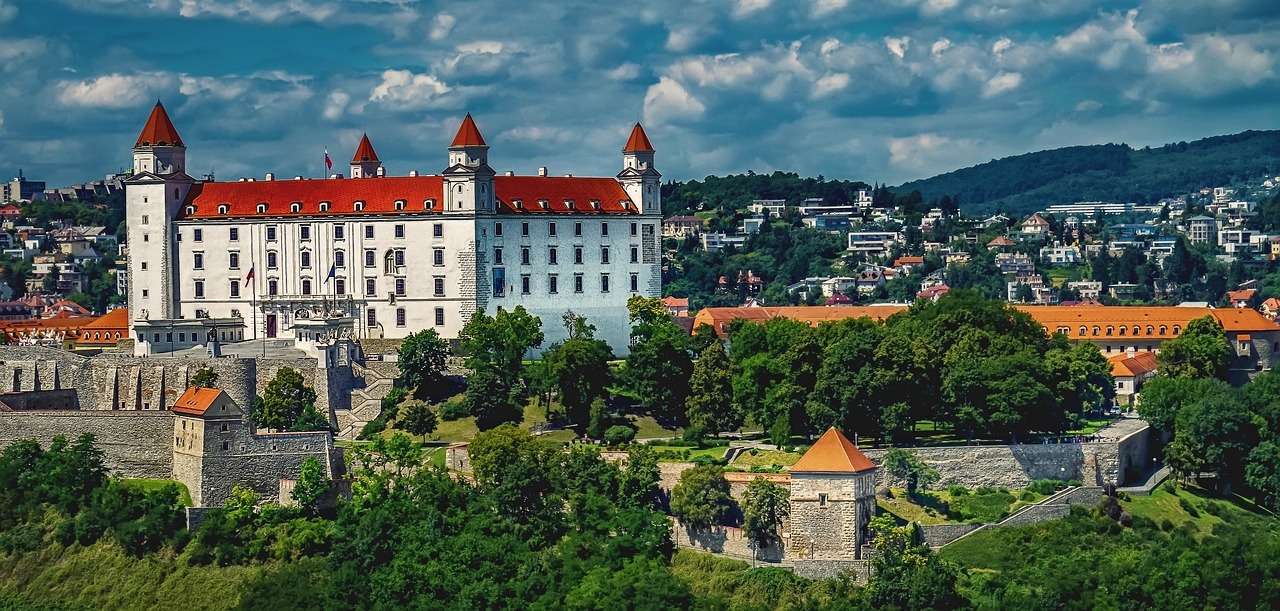
- The castle on its hill — a white foursquare rebuilt from ruin — is less about the museum than the ramparts: the Danube below, and on clear days Vienna’s wind farms on the horizon you just came from.
- The old town packs its squares tight: Michael’s Gate, the Main Square’s embassies and cafés, and the working-sized charm of a capital of half a million.
- The Blue Church — Art Nouveau in wedding-cake blue, ten minutes east of the center — is the photograph everyone leaves with.
- The UFO observation deck tops the Communist-era bridge pylon for the panorama with the best origin story; the castle’s free version competes well.
- Lunch is the hidden agenda: Slovak kitchens and Danube-side terraces at prices Vienna forgot existed. Halušky with sheep cheese is the national argument — take it. City details at visitbratislava.com.

Getting there
Hourly trains make this the least dramatic border crossing in Europe: Wien Hbf, sixty-odd minutes of Pannonian flat, and you’re in a second capital before the coffee wears off. The day-return excursion fare covering Bratislava’s transit is the ticket to ask for. Seasonal boats run the Danube between the cities for those wanting the river version — slower, pricier, and a legitimately good time one way. From Bratislava’s main station, tram or a fifteen-minute walk reaches the old town.
The day
Climb to the castle first while legs are fresh — through the old fortification gates, up to the ramparts, and the four-towered silhouette that’s on every label of everything Slovak. Descend into the old town for the compact circuit: Michael’s Gate and its street of cafés, the Main Square, the cathedral where Hungarian kings were crowned for centuries while the Turks held Budapest. Lunch long and cheap, per the bullets. The afternoon takes the Blue Church detour, a Danube-bank walk to the UFO bridge, and coffee wherever the sun is. Trains run into the evening; there is no schedule pressure worth feeling.
When to go
Spring through early autumn is terrace season on the Danube; December converts the squares to Christmas markets that undercut Vienna’s on both crowd and price. Summer weekends bring stag parties in costume — a known feature, easily orbited. Winter otherwise is quiet, cheap, and short-houred. The hourly trains make this the most weatherproof day trip Vienna offers: bad forecast, castle museum and long lunch; good forecast, ramparts and river.
Frequently Asked Questions
Is Bratislava worth a day against Vienna’s own attractions?
As a contrast, absolutely: a small, fast-changing capital with a different century’s worth of history per block, at half the prices. It reads best as Vienna’s counterweight rather than its competitor.
Train or Danube boat?
Train for frequency and cost; boat one way in season for the river experience. The classic combination is boat out, train back.
Do I need Slovak currency?
Slovakia uses the euro — one less thing. Cards run everywhere; the price drop from Vienna is the only monetary event.
Is the castle museum worth entering?
The ramparts and grounds, free, are the point for most visitors. The history museum inside serves those wanting the full Slovak national story; on a tight day, skip inside and keep the view.
What about Devín Castle?
The dramatic ruin at the Morava confluence sits a short bus ride from town and adds two fine hours for castle-lovers. It’s the reason to consider a longer Bratislava day rather than a squeezed one.